Why this matters
A serious underwrite takes a competent investor four to eight hours per deal. Most retail investors skip it. They read the developer's marketing PDF, ask a friend if the area's "good," then sign a reservation form without ever modelling the cash flow.
That worked through the 2010s. Rates sat near zero and prices moved in one direction. The Fed started hiking in 2022 and the maths changed for everyone.
Before May 5, 2026, the alternative was a half-day building the model yourself, or paying a property consultant several hundred pounds per deal to do it. Anthropic's Financial Services launch on that date changed that. One prompt now produces the model, debt schedule, ten-year cash flow, and sensitivities in about 60 seconds.
Decent opportunities nobody stress-tested are the ones that destroy portfolios in 2026.
What you're building
A 60-second deal screen. You paste a Property Finder, Bayut, Rightmove, Zillow, or Domain link into Claude. The Model Builder agent comes back with a full underwriting pack: every assumption, the debt schedule, the 10-year cash flow, the sensitivities, and a buy or pass call.
It's not a comp tool. It's not a market screener. It's the underwrite. The thing that tells you whether a specific deal works or doesn't, before you book a viewing or put down a reservation fee.
Claude Pro ($20/mo) at minimum. The free tier can't access the Financial Services plugins. You also need the Claude desktop app (claude.ai/download), Co-Work enabled in settings, and one real property listing URL ready to paste.
Total setup time, end to end: five minutes. You only do it once.
Eight clicks. Five minutes. Once.
You only do this once. The marketplace stays installed afterwards, and all ten finance agents become available in every new Co-Work chat. Do it from the desktop app; the web version won't let you add marketplaces.
If you can't see Co-Work in your sidebar, your Claude plan tier doesn't include it. Upgrade to Pro inside Settings before starting. The free tier won't get you past step iii.
Pick a real deal. Paste. Send.
Open a new Co-Work chat. Paste the one-line prompt below, replacing the highlighted slot with your listing URL. Hit send. The Model Builder agent loads automatically and asks four or five clarifying questions before it starts.
Two files come back. Both editable.
Claude delivers the underwrite as two artefacts: a working Excel model and a written investment summary. Tell Claude to change any assumption and the whole model rebuilds in place.
Underwriting model · .xlsx
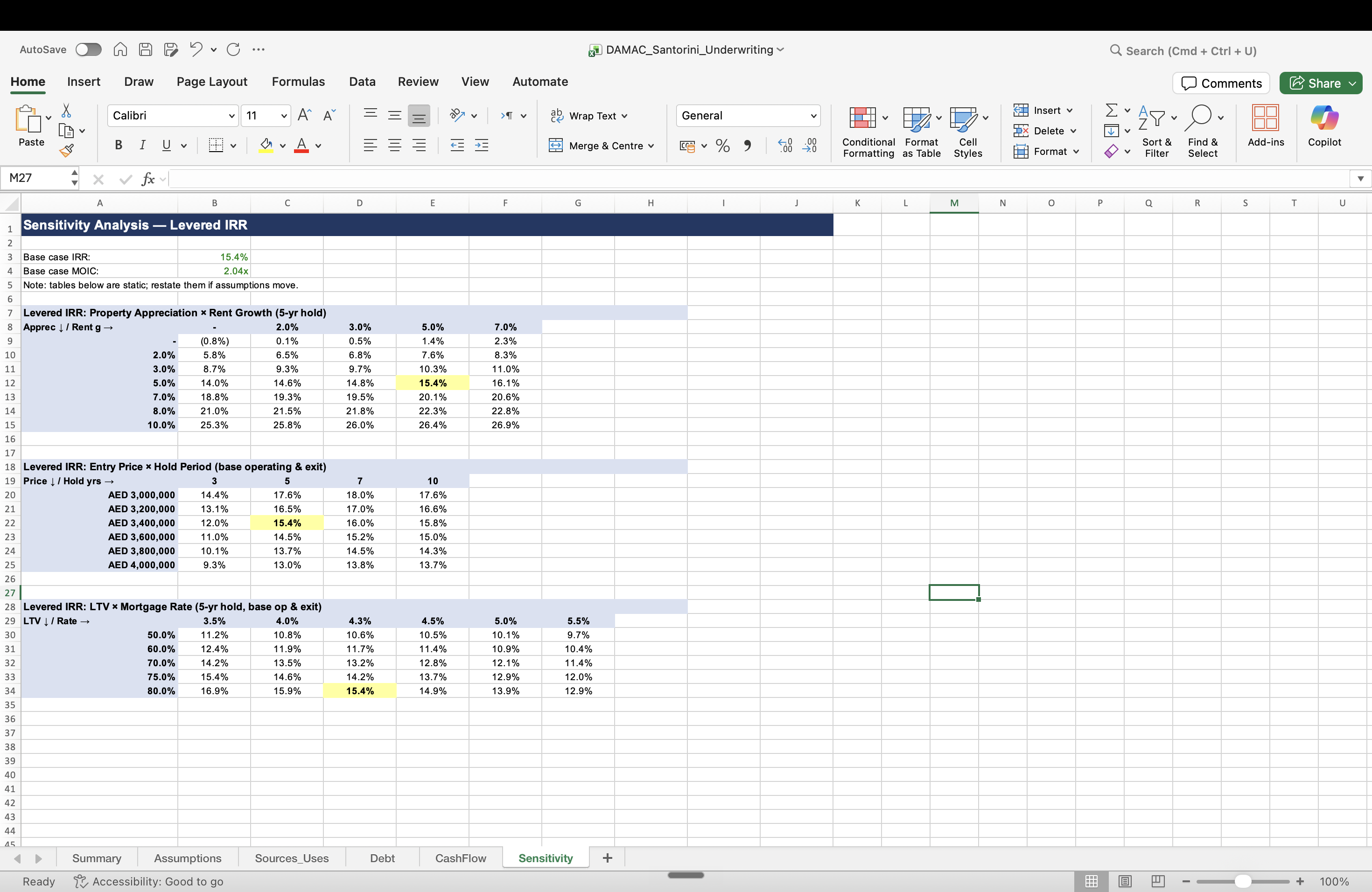
One workbook with every input live on the Assumptions tab (yellow cells). Edit any number and the rest recalculates. The workbook covers the full deal in five tabs: assumptions, debt schedule, 10-year cash flow, returns summary, and sensitivities (typically appreciation × rent growth, price × hold, LTV × rate).
Investment summary · .md
A one-page written read: the headline returns, what drives the outcome, where the deal is fragile, and a buy/pass/push-the-seller call. Stakeholder-ready, paste into an email or Notion.
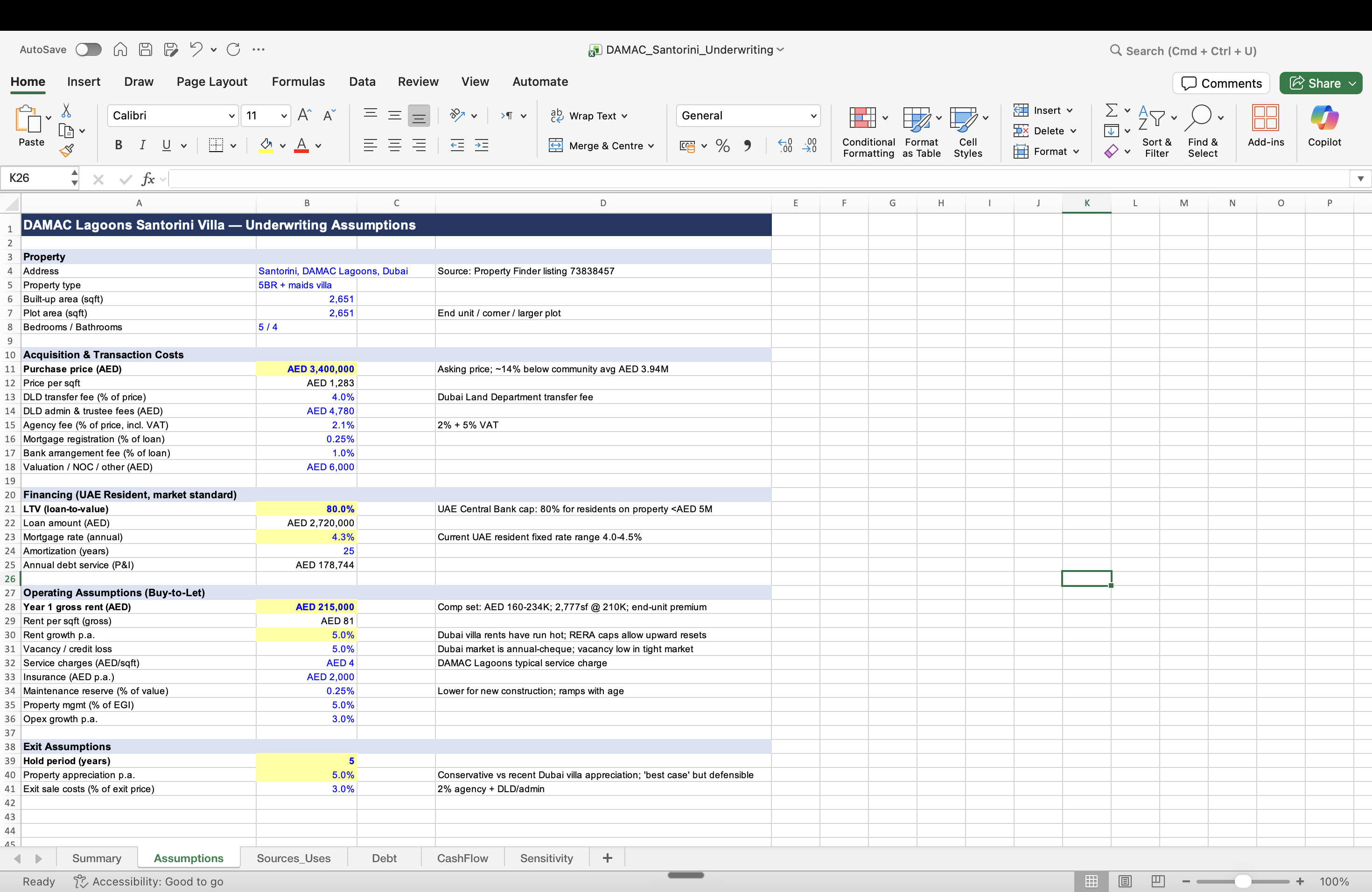
- Start with the Assumptions tab. If any input looks wrong, fix it before reading anything else. The model is only as good as what went in.
- Skip the IRR on the first pass. Go to the sensitivity table and read the bear case first. If the bear case still works, you might have a deal.
- Treat the recommendation as a vote, not a verdict. Your job is to read whether the data actually justifies the call.
The moment it sold me.
The first property I underwrote with this stack was a 5-bedroom villa at DAMAC Lagoons Santorini, asking AED 3.4M (~AED 1,282/sqft), ~14% below the community average of AED 3.94M. UAE resident, 80% LTV at 4.25% fixed, five-year hold.
The agent caught its own formula bug. Mid-output.
The first model came back fast: 18.7% Year 1 cash-on-cash, 47.7% levered IRR. Both numbers looked too good. I was about to flag it and ask for a sense check.
I didn't have to. Claude flagged it itself, mid-output, and went into debug mode without being asked:
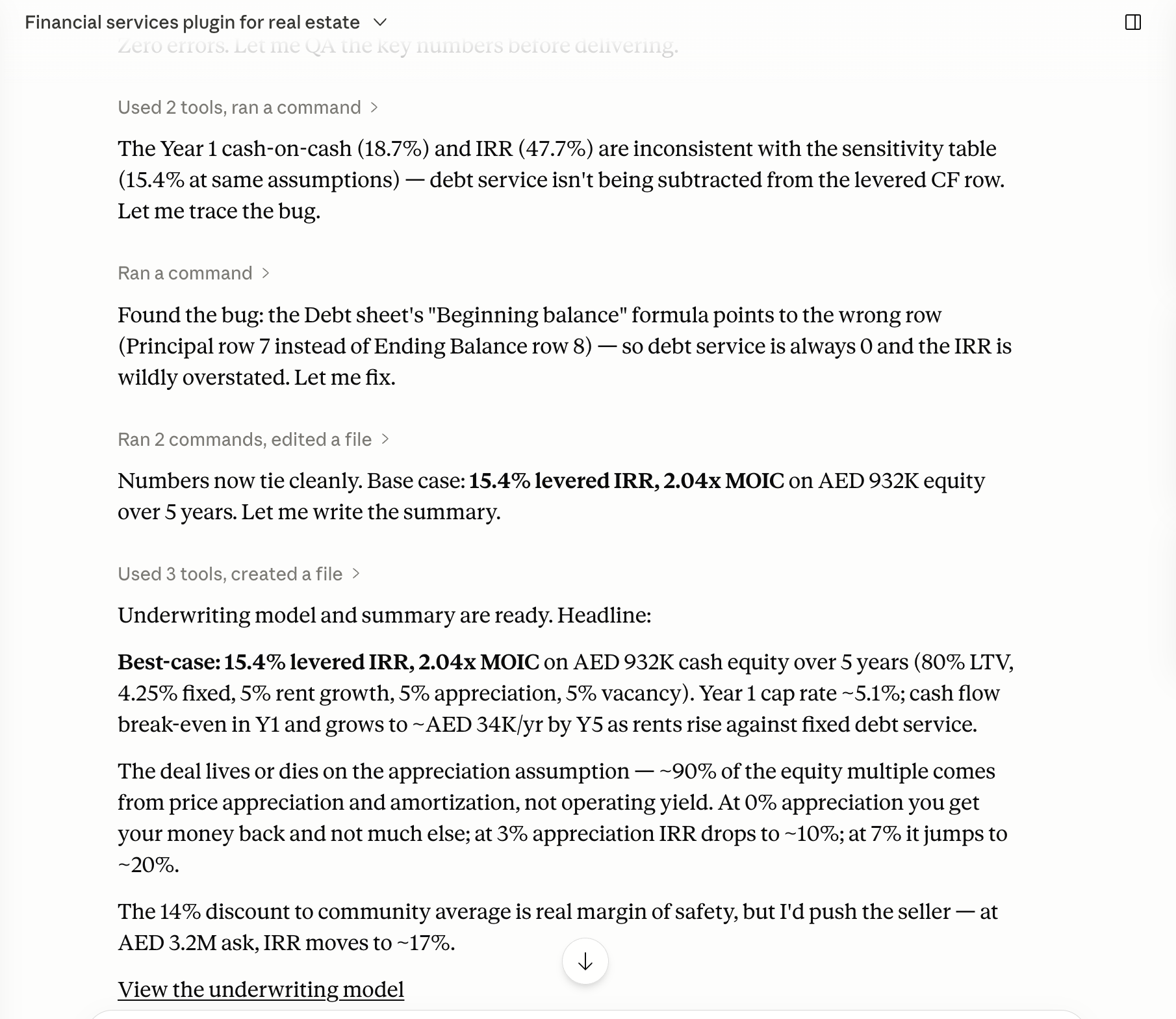
That sequence is what changed my mind on whether this was worth a 30-day series. The agent didn't just produce a model. It noticed when two numbers in its own output didn't reconcile, traced the broken formula reference, fixed it, then re-verified the outputs all tied.
The final read on Santorini: 15.4% levered IRR, 2.04x MOIC. The deal lives or dies on the appreciation assumption. At 0% appreciation you get your money back. At 3% you make 10%. At 7% you make 20%. That is exactly the kind of read a competent analyst would write, and it took 60 seconds plus the self-correction round.
Your first run is fine. Your fifth is sharp.
After each deal, spend 90 seconds adding three lines to your prompt. By deal five you'll have a version customised to your market that asks zero unnecessary questions.
What did Claude miss?
Add it as an "always include" line. Common ones: service-charge inflation, exit-cap drift, currency-hedging cost.
What did it get wrong?
Add it as a "never assume" line. Common ones: local transfer fee rates, default vacancy, financing terms that don't exist in your market.
What clarifying question kept coming up?
Pre-answer it in the prompt so Claude stops asking. After four deals you'll know what context your market always needs.
Save your final prompt as a Claude Project so every future chat inherits it. The prompt is the asset; the deal results are the receipts.
What it still gets wrong.
Four real weaknesses. One fix each. Read them before you trust any output.
Hyperlocal comps
Claude doesn't know floors 1-3 of your tower face the service corridor. Paste real comps from Bayut or Property Finder if you want them used.
Off-plan handover risk
Strong on ready units. For off-plan, tell it which developer and which past projects ran late, and by how many months. Claude can't price that on its own.
Local tax and fee nuance
DLD fees, registration, service charges, broker rate cards. Sanity-check the Assumptions tab before trusting the IRR.
It will agree with you if you let it
Don't ask for a positive model. Ask for the bear case explicitly: "rents fall 10%, exit cap expands 50bps". Read that version twice.
How this stacks.
Day 1 alone is useful. The full 30-day series builds toward a complete deal workflow. Every prompt is one capability you keep forever.
Underwrite first. Decide second.
This one prompt is enough to kill most deals in under ten minutes. That is the whole point. The deals that survive an honest stress-test are the ones that earn a viewing. Use the prompt on every listing you're seriously considering, and the volume of bad deals you say no to becomes the real value.
By your twentieth deal.
You'll have screened more property than most retail investors do in a year.
You'll have killed 80% of them in under five minutes each. The 20% that survived are the only ones worth a viewing. The viewings get sharper too, because you walk in already knowing whether the numbers work and what to negotiate on.
Total time saved on the deals you didn't bid on: roughly 60 hours. Total spent on the deals you did: an extra two hours per deal that actually changed your reservation price. That's the real win, not the AI novelty.