A free guide by FourthspaceOS INSTAGRAM WAITLIST
Day 09 · 30 Prompts in 30 Days

Your off-plananalyst.Inside Claude.

Off-plan buyers hand a developer two to four years of payments based on a brochure. Day 09 builds a Claude Project that pulls the market reports, the SPA, the payment plan, and the developer's actual handover record into a single grounded analyst. The diligence layer the brochure was never going to give you.

Why this matters

Off-plan made up roughly 60% of all Dubai residential transactions across 2024 and 2025, according to Dubai Land Department data. The buyer typically pays in stages across two to four years before the keys exist, against a brochure designed to sell, not to inform.

The four ways an off-plan buyer actually loses money are well known: handover delay, spec downgrade, oversupply at completion, and developer default. None of them appear in the marketing pack. All of them appear if you assemble the right documents in one place and ask grounded questions of them.

This guide builds that one place. A Claude Project, locked to the documents you provide, that turns the SPA, the payment plan, the master plan and the developer's actual past delivery record into a research file that survives the two-year wait to handover.

The brochure is the marketing. The numbers are the investment.

What you're building

The end result

One Claude Project per off-plan tower or community you are seriously considering. Every document you have on it lives inside that one Project.

The outputs: a market overview written from real published research, a bull case memo, a bear case memo covering the four off-plan failure modes, and a quarterly check-in that asks the same question of every new construction update.

What you need

Claude Pro or Max, to access Projects with file uploads and longer context windows.

Quarterly market reports from Knight Frank, JLL, CBRE, Bayut and Property Finder. All free PDFs from their respective websites.

The developer paper trail: brochure, payment plan, SPA, escrow account details, master plan, and a list of the developer's last five completed projects with promised vs actual handover dates.

About 45 minutes. Fifteen to gather the documents, fifteen to set up the Project, fifteen to read the memos Claude returns.

Step 01 · Create the Project

One Project. One tower.

Open Claude, go to Projects, click New Project. Name it after the specific off-plan development you are researching, not a generic label. "Bayview Tower B by Sobha" beats "Off-plan analyst" because it stops cross-contamination between two different research files.

i.In Claude, open the Projects tab and click New Project.App
ii.Name the project after the specific development. e.g. "Bayview Tower B by Sobha · Dubai Creek Harbour".Name
iii.Paste the project instructions below into the Project knowledge instructions field.Lock down
01
The project instructions

Lock the analyst to your documents.

Tells Claude to work only from the files you upload, and to refuse to invent prices, yields or handover dates. The single most important step in the whole workflow.

Paste into Project instructions
You are an off-plan property research analyst. You work only from the documents I upload to this Project. Hard rules: 1. Do not use outside knowledge of this development, this developer, this submarket, or the wider Dubai market. If a number is not in the uploaded documents, say "I cannot verify this from the documents in this Project" and stop. 2. Do not speculate about handover dates, rental yields, transaction prices, or future supply. Quote them only when they appear in a named document I have uploaded. 3. Cite the source document and section for every factual claim. e.g. "Sobha brochure, p.14" or "Knight Frank Q1 2026 Dubai Residential, page 8". If a claim has no document source, do not make the claim. 4. When I ask you to write a memo or analysis, always include a "What I cannot verify from these documents" section at the end. List every assumption a reader would need to confirm independently. 5. Default tone is grounded, sober, and quantitative. No marketing language. No emojis. I will upload three categories of document over the next few prompts: market reports, developer documents, and (later) quarterly updates. Wait for them before producing any analysis.
Why the lockdown matters

Without these instructions, Claude will fill gaps from its training data: invented transaction comps, made-up rental yields, soft estimates of handover delay risk that sound authoritative. You will not be able to tell which numbers are real and which are hallucinated. The whole workflow depends on this step.

Step 02 · Market overview from published research

Ground the analyst in real research.

The Project is locked, so it cannot rely on Claude's training data for market context. You give it real, dated research instead. The big property research houses publish quarterly Dubai market reports as free PDFs. Pulling five of them is fifteen minutes of work and gives you a market overview an analyst would have charged a thousand pounds to write.

The five free Dubai market reports to upload

Knight Frank · Dubai Residential Market Review. Quarterly. Strongest on prime and super-prime price movement, off-plan absorption, and high-net-worth buyer behaviour.

JLL · Dubai Real Estate Market Overview. Quarterly. Strongest on supply pipeline forecasts by submarket and grade.

CBRE · Dubai Residential Market Review. Quarterly. Strongest on transaction volume splits, rental performance, and yield trends.

Bayut · Dubai Sales & Rental Market Report. Quarterly. Strongest on consumer search demand and area-level price-per-sqft trends.

Property Finder · Dubai Market Watch. Quarterly. Strongest on off-plan vs ready transaction splits and developer activity.

02
The market overview prompt

Submarket. Demand. Supply.

Once the five PDFs are uploaded to the Project, paste this. Claude triangulates across all five reports to give you a submarket overview, with every claim cited.

Paste once all five reports are uploaded
Using only the market reports I have just uploaded, write me a market overview for the submarket and price band of the off-plan development I am researching. Cover: 1. Demand. Where is end-user and investor demand coming from in this submarket right now? Cite figures and quotes from the uploaded reports. 2. Supply. What is the existing supply pipeline in this submarket over the next 24 to 36 months? List the named competing projects if the reports mention them. 3. Resale absorption. How quickly do similar-grade units in this submarket currently resell? Cite days-on-market or absorption figures if available. 4. Price trends. What is the per-sqft trajectory for this submarket over the last 8 quarters? Note the direction and the magnitude. 5. What could structurally kill resale value at handover. Pull this from the reports, not from your training data. For every claim, cite the report, the quarter and the page. End with a "What I cannot verify from these documents" list.
Step 03 · The developer paper trail

Every document. One file.

This is the part most retail off-plan buyers skip. You upload the full set of documents that constitute the actual investment, not just the brochure. Five of them are project-specific. The sixth is the developer's actual delivery record. The sixth is the underrated one.

From the developer

The named project pack.

Ask the broker or developer sales agent for the full set. If they will not send the SPA or escrow account details before reservation, that is itself a signal.

  • Project brochure · spec, finishes, amenities
  • Payment plan · milestones + post-handover
  • SPA · sale & purchase agreement
  • Escrow account details · RERA-registered
  • Master plan · community + phasing
The track-record file

Their last five completed projects.

The single most predictive document in the pack. For each of the developer's last five completed Dubai projects, list the originally promised handover date alongside the actual handover date and final unit count.

  • Project name + community
  • Originally promised handover
  • Actual handover date
  • Delay in months
  • Final units delivered vs launched
Where to find the track record

The developer's website rarely publishes the original-vs-actual handover dates. The cleanest sources are RERA's Dubai REST app (search past projects by developer name), broker WhatsApp groups (delays are openly discussed once a project completes), and the dated launch announcements in property news archives. Twenty minutes of cross-referencing is enough to build the file.

Step 04 · Bull case + bear case

Two memos. Three years of cover.

With the market context written and every project document loaded, you ask Claude to write the two memos a real institutional buyer would have written before signing the SPA. One bull, one bear, both grounded in your uploaded documents. You will reread them when the second payment milestone hits and you are wondering whether to flip or hold.
03
The bull memo prompt

Why this is a buy.

Asks Claude to make the strongest grounded case for owning this off-plan unit at this payment plan, using only the uploaded documents.

Paste after Steps 01 to 03 are complete
Using only the documents in this Project, write me a bull case memo for buying this off-plan unit at the payment plan in the SPA. Structure: 1. The thesis in one paragraph. Why this unit, this submarket, at this price, on this payment plan. 2. The three strongest grounded reasons to own it, each backed by a citation from a specific uploaded document. 3. The capital growth case. Quote per-sqft trajectory from the market reports and the project's pricing in the brochure. 4. The yield case. Quote the rental performance figures for comparable units in this submarket from the uploaded reports. 5. The payment plan advantage. Walk through what the cash outflow looks like across the construction period and why the structure favours the buyer if the thesis holds. 6. The exit options. List the realistic exits Claude can support from the documents: resale before handover, hold-to-rent, hold-to-occupy. End with "What I cannot verify from these documents". List every assumption a reader would need to confirm independently.
04
The bear memo prompt

How you lose money.

Forces Claude to play the adversary. Four named failure modes, each backed by what the uploaded documents do and do not say.

Paste immediately after the bull memo
Using only the documents in this Project, write me a bear case memo covering the four ways an off-plan buyer typically loses money on a unit like this. For each failure mode below, give me a paragraph on how likely it is given what the uploaded documents say, and a paragraph on the loss size if it happens. Cite the source document and page for every claim. 1. Handover delay. Use the developer's last five completed projects and their original-vs-actual handover dates. How many months of slippage is plausible? What does that mean for my opportunity cost on the deposit? 2. Spec downgrade. What is and is not legally fixed by the SPA? Where can the developer substitute finishes, amenities, or unit layouts? Quote the clauses. 3. Oversupply at completion. From the market reports, how much competing supply lands in this submarket in the 12 months around expected handover? How does that affect resale absorption and the rent number a tenant would pay? 4. Developer default. What does the escrow structure protect? What does it not protect? What is the recourse if the developer pauses construction or sells the project to a successor? End with "What I cannot verify from these documents" and a list of the highest-priority follow-up questions to ask the broker or developer before signing.
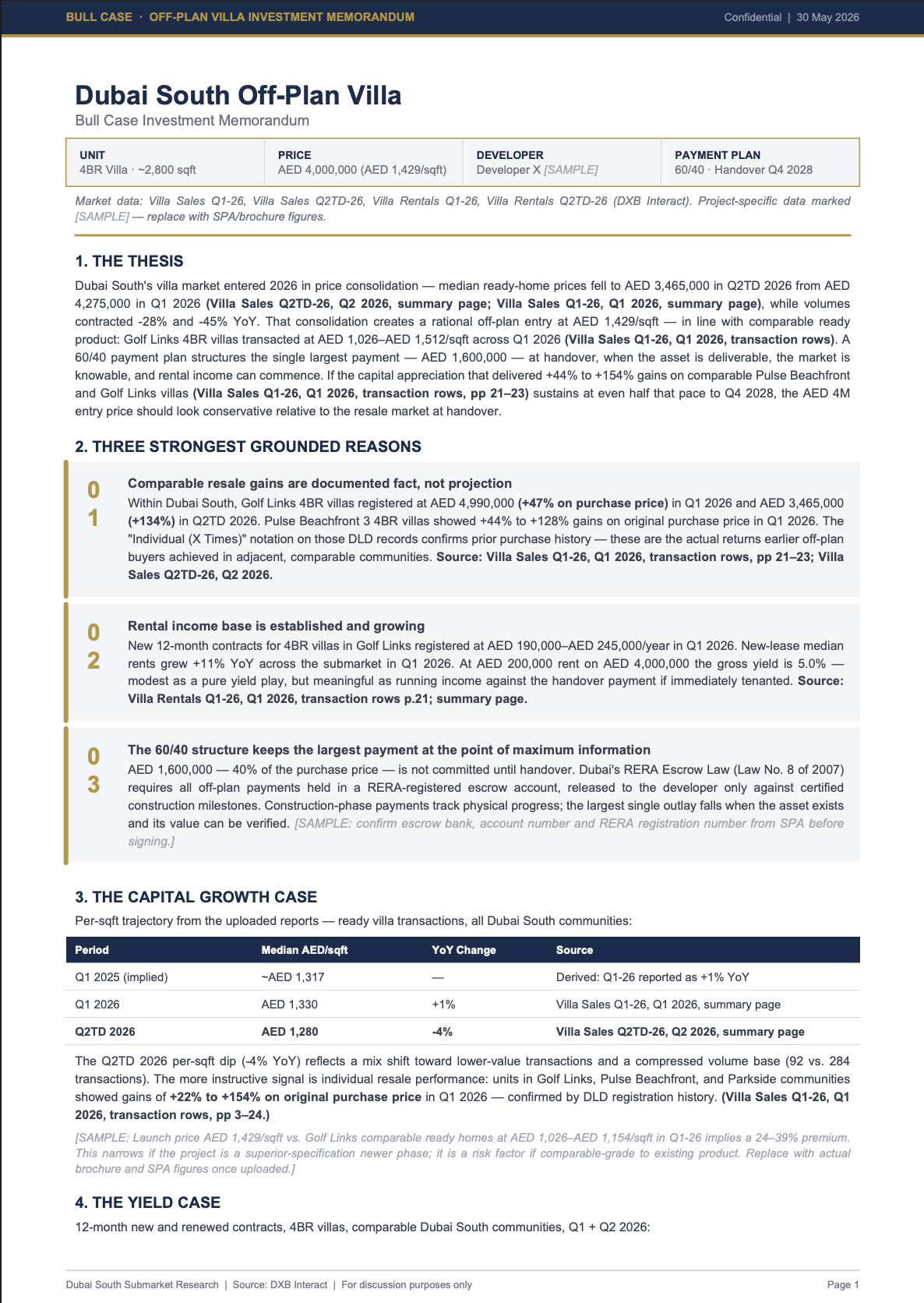
The bull case The bull case memo Claude returned, grounded in the uploaded documents
Why this off-plan unit is a buy at this payment plan, with every claim cited.
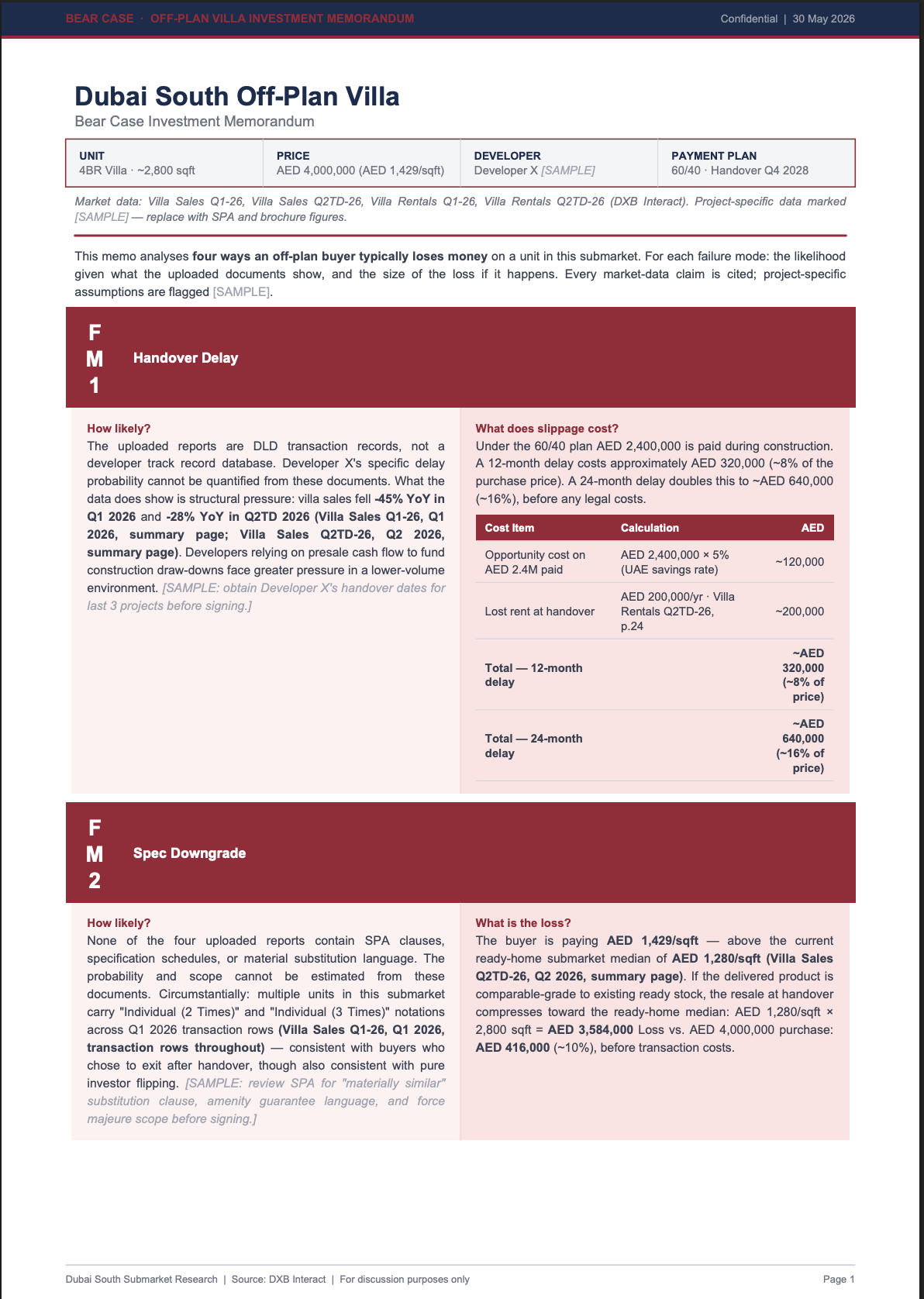
The bear case The bear case memo covering handover delay, spec downgrade, oversupply and developer default
Handover delay, spec downgrade, oversupply at completion, developer default.
When the bear is stronger than the bull

If the bear memo lists handover-risk paragraphs the bull memo cannot answer, that is the workflow doing its job. The cost of the Pro subscription has paid for itself many times over compared to a deposit on a project that ships eighteen months late. Read the bear memo last, before you sign anything.

Step 05 · Quarterly pulse

Same question. Every quarter.

An off-plan investment is a two to four year position. The reason a Project beats a folder of PDFs is that you can ask the same grounded question of new information as it arrives. Every quarter, you add three things and ask one question.

i.Add the developer's latest construction progress update and any new milestone payment notice.Add
ii.Add any new launches announced in the same community or submarket over the last three months.Add
iii.Add the latest DLD transaction data for comparable units in this submarket. The Dubai REST app exports a CSV.Add
05
The quarterly check-in prompt

What changed. What did not.

Asks Claude to compare what the developer promised, what the market is doing, and whether the bull or the bear case is now stronger than at the last check-in.

Paste once the three updates are uploaded
Using only the documents in this Project, including the new updates I just added, answer the following. 1. Is the developer hitting the milestones they promised? Compare the latest construction update against the original payment-plan timeline in the SPA. Quote any delays. 2. What new competing supply has been announced in this submarket since the last check-in? Cite the launch announcements. 3. What direction are resale prices for comparable units in this submarket trending? Quote the latest DLD figures and compare to the trajectory in the original market overview. 4. Is the bull case stronger or weaker than it was at the last check-in? Cite the specific documents that moved the needle. 5. Is the bear case stronger or weaker? Walk through each of the four failure modes again and note any updates. End with "What I cannot verify from these documents" and three follow-up questions for the broker or developer this quarter.
The honest bit

What this does not replace.

Four limits worth knowing before you treat the Project as the source of truth.

i.

It does not visit the site

Construction quality, access roads, neighbouring noise, finished community feel: none of this lives in a document. The Project is the desk research layer. A site visit, even at structure stage, is still the one thing that has no AI substitute.

ii.

It cannot see what is not disclosed

Off-balance-sheet developer issues, quiet launches that are not yet in the reports, escrow drawdown timing that is opaque to the buyer: the Project only knows what its documents say. Treat absence of a risk as inconclusive, not as reassurance.

iii.

Bad inputs poison the analysis

If the only document you upload is the developer's brochure, you get the brochure's narrative back in memo form. The whole point of Steps 02 and 03 is to balance the developer's marketing with independent research. Skip them and the Project is just a glossy summariser.

iv.

It is not financial advice

Your lender's appetite, your tax position, your personal timeline, your existing portfolio exposure: none of this is in the Project. The memos are research. The decision is still yours, and worth running past a regulated adviser before signing.

The workflow

How this stacks.

Days 01 to 06 built the tools for what you already own: an underwriter, a strategist, a marketing-claims check, five connected MCPs, the Small Business plugin, and a property-manager dashboard. Day 09 turns the same toolkit on what you are about to buy. The off-plan deposit you are weighing right now.

The workflow

Earlier days manage what you own. Day 09 protects what you are about to buy.

An off-plan reservation is the single largest unhedged decision most retail investors make. The Project you build today is the file you reread the night before the second milestone payment, when the developer is quiet and the resale market has moved. The cost of running it is one Claude subscription. The cost of skipping it is the deposit.

What "done" looks like

By the second milestone.

The first-year vision

Three memos. Two years of cover.

By the time your payment plan's second milestone hits, the Project will hold the bull memo, the bear memo, and the first quarterly check-in. You will know whether the developer is on schedule. You will know what new supply has been announced. You will know whether resale prices are running with you or against you.

The shift is not that Claude becomes an off-plan broker. It is that the part of the decision that depended on being a sophisticated buyer with paid analysts now sits inside a Pro subscription. The deposit is yours to risk. At least make it an informed risk.

06
Where this builds from

Day 06 · Turn Claude into your property manager.

Read Day 06
FourthspaceOS

An operating system for property investors.

Every prompt in this 30-day series is one capability. FourthspaceOS bundles all of them into a single product: underwriting, comps, market research, deal sourcing, portfolio tracking, and investor reporting. The product runs natively on the same Anthropic agents and plugins you are learning to use this month.

Waitlist members get founding pricing, early access, and one new prompt delivered each day for the next 30 days.

Join the waitlist

Founding pricing locks in for waitlist members.

One email a day for 30 days. No spam. Unsubscribe whenever.

Share the guide

Know someone about to put a deposit down on off-plan?

Most retail off-plan buyers sign before they have read the SPA properly, let alone cross-checked the developer's actual handover record. Send them this page. Forty-five minutes of work now beats a two-year wait for a unit that arrives late, smaller, or in a finished community of empty towers.

Find me on Instagram
Use it today

Build your first off-plan Project before the weekend.

Pick the one development you have been seriously considering. Open Claude, create the Project, paste the instructions from Step 01. Upload the five free market reports in Step 02. Pull the developer paper trail in Step 03. The bull and bear memos will write themselves once the documents are in place.

Back to Step 01